
Redesigning the Sky: Why Aircraft Interiors Are Becoming Aviation’s Most Strategic Space

Andrea Mocellin, Automotive and Aviation Designer, Founder of Revolve Mobility and part of the Cabin Collective for Aircraft Interiors Expo (AIX) 2026
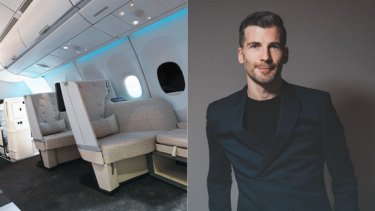
Aircraft interiors are no longer simply about fitting passengers into a certified volume. They are becoming one of aviation’s most strategic performance arenas where engineering discipline, brand identity, human psychology, and operational economics converge.
As ambassador for this year’s AIX, I see a profound shift taking shape. The cabin is moving from being a reactive outcome of aircraft architecture to becoming a proactive driver of value. Design is not decoration. Design is performance. And increasingly, it is also responsibility.
I often describe this transformation through what I call the “Passenger Experience Ratio,” the ability to translate aviation’s strict constraints into spatial clarity, emotional reassurance, and long-term business impact. Weight targets, certification complexity, durability requirements, and sustainability pressures are not barriers to creativity. They are the framework within which meaningful innovation must happen.
Today’s passengers compare their flight experience not only with previous journeys, but with premium automotive interiors, digital ecosystems, contemporary architecture, and hospitality environments. They expect continuity. They expect belonging. Most importantly, they expect clarity.
Inside the cabin, clarity means intuitive space, readable environments, and a sense of control. Passengers want to understand where they are, how they move, and how the space supports their comfort and safety. They want privacy without isolation, openness without exposure. They want an environment that feels designed for them, not imposed on them.
This shift is redefining design authority.
An inside-out approach where structural performance, exterior architecture, and interior experience are conceived as a unified system is becoming essential. In advanced aircraft programs and emerging aerial mobility platforms, transportation is no longer the only objective. The real challenge is to create environments that feel trustworthy, seamless, and emotionally aligned with the broader mobility journey.
This journey increasingly begins long before boarding. Airports are transforming into experience hubs. Airline lounges, mobility interfaces, and urban transport connections are being redesigned to reduce friction and frustration. The cabin must now act as a natural continuation of this ground experience not as a disconnected chapter.
Lightweight innovation is a key enabler of this evolution. Once seen as a purely technical constraint, lightweighting is now a spatial and experiential opportunity. Advanced composites, additive manufacturing, and hybrid material strategies allow designers to rethink seating architectures, monuments, and layouts in ways that enhance ergonomics, visual clarity, and operational flexibility.
Reducing mass improves sustainability performance but more importantly, it unlocks new design freedom.
At the same time, new air mobility platforms are radically challenging traditional cabin thinking. Electric vertical take-off and landing aircraft, hybrid propulsion concepts, and distributed mobility networks are redefining spatial typologies, passenger interaction models, and expectations of personal space. These emerging realities are not isolated from commercial aviation. On the contrary, they are accelerating the need for airlines and manufacturers to anticipate new trends in materials, configuration logic, and experiential design.
Innovation in aircraft interiors therefore requires a rigorous multidisciplinary process. Key initial sketches and ideas, digital modelling, immersive visualisation, rapid prototyping, mock ups, and real-world validation must operate in a continuous loop. Certification realities must be understood early. Lifecycle thinking must guide decisions. Passenger emotion must be tested, not assumed.
Cross-mobility design leadership becomes critical in this context. Professionals working across automotive, urban mobility, aerospace, and new aerial systems are uniquely positioned to build coherent experiences across scales. They can translate innovation from one domain into meaningful progress in another.
Looking ahead, aircraft cabins will become key nodes within an interconnected mobility ecosystem. Designing them means shaping not only physical space, but trust, orientation, and human confidence within increasingly complex technological environments.
Industry platforms like AIX play a fundamental role in accelerating this transformation. They create the space for bold thinking, real collaboration, and strategic alignment.
Ultimately, the future of aviation will not be defined only by propulsion technologies or operational efficiency. It will be defined by how intelligently we design environments that passengers recognize as their own.
And that is where true design authority begins.
Discover Aircraft Interiors Expo
Looking for something else?